LLearning With LLMs!
Data Justice Issue:
This webzine serves the purpose of leveling the information gap. In the past, access to good quality of support in education has been only for higher income individuals who can afford tutors, but language learning models (LLMs) can help lower income students that cannot afford tutors use AI to help them in school.
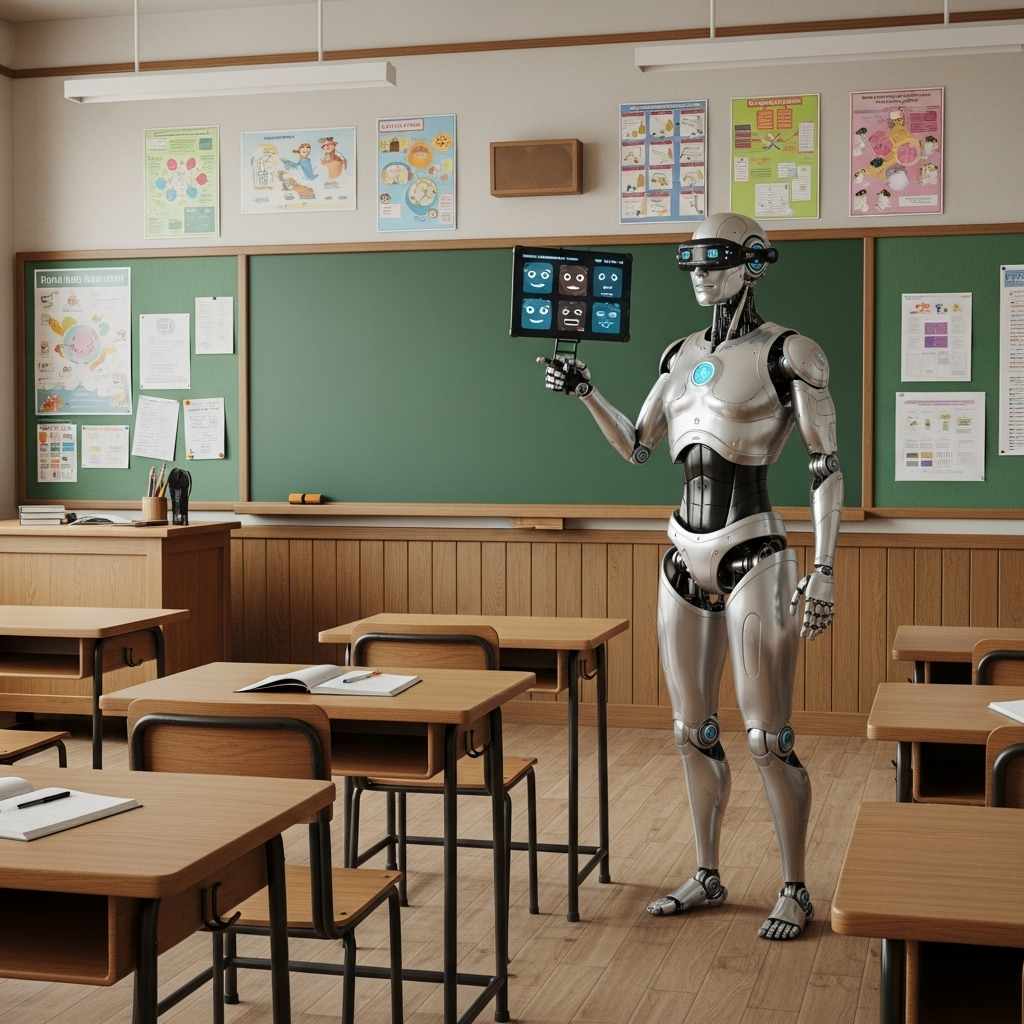
AI can be used as an Intelligent Tutoring System (ITS). ITS are able to personalize an individual's learning experience and can help students learn outside of school, which gives them a similar effect to hiring a tutor. Many ITS work by creating questions that are on the “learning edge” of the student, meaning problems that are on the brink of their comfort zone. Based on patterns, AI predicts which questions they will be able to answer correctly, or at least understand. The techniques these models use are quite successful, and in most cases ITS have shown to improve test scores (Gillani 102-103). In a controlled analysis of ITS, across 50 cases the ITS helped improve the performance of the student in 46 of them. Additionally, the results were on average more effective than human tutors, which shows the viability of ITS as a tutor (Kulik 67).
However, it is not to say that ITS comes without its downsides. One of the biggest issues that ITSs creates is that it limits the scope of what learning can mean. “‘Learning’ in these applications typically consists of students engaging in computer-based activities and producing ‘correct’ or acceptable answers within a limited range of predetermined responses” (Williamson 13). Furthermore, even though these systems will often yield the correct result for a given problem, the intermediate steps that they showcase are often inconsistent and sometimes misleading (Gupta 12).
While LLMs do exhibit noticeable limitations in regard to tutoring when compared to the ability of real human professionals, the main appeal of these systems is their accessibility to users with limited educational resources. The ability that these systems have to adapt to varied user input formats and clarifying questions makes them an affordable and readily available tutoring resource, which is exactly why it is important for users to learn about and take advantage of these platforms.
Helpful AI Tutors by Subject
- Interdisciplinary: Cognispark AI is the best, changing how it teaches as the student learns to cater to someone’s specific needs. It also has information about a range of topics.
- Math: Khanmigo, which is Khan academy’s AI, it is one of the best options for learning math concepts.
- Studying/testing: Quizlet is a flashcard site that has implemented AI features which are pretty good.
Examples of Good Prompts and Their Responses (using ChatGPT):
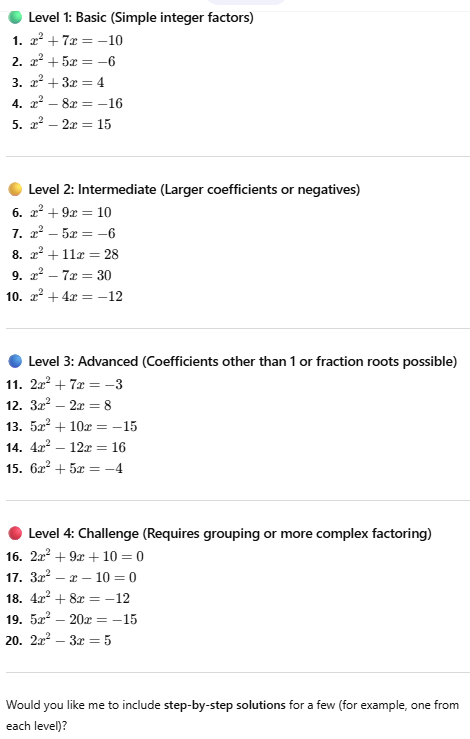
MATH: Create a set of factoring practice problems similar to (x^2+6x=-5) with varying degrees of difficulty
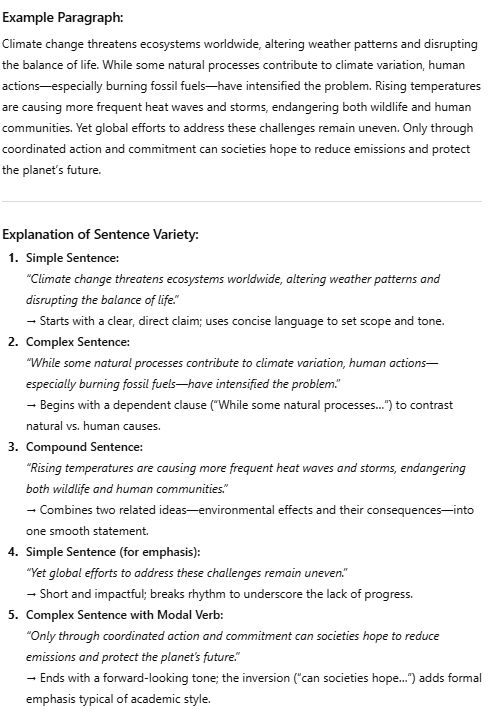
WRITING: Provide an example of an academic style paper with an emphasis on varying sentence structure.
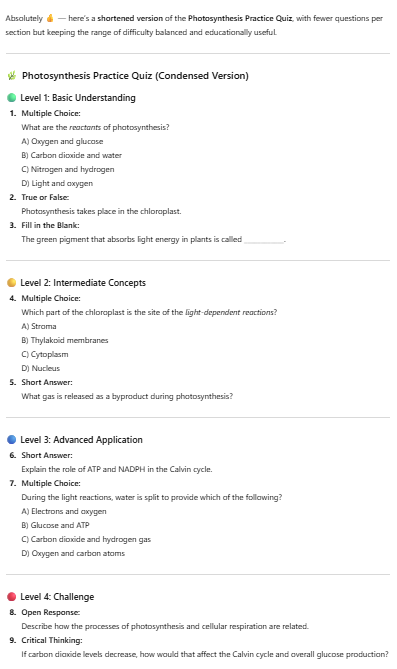
SCIENCE: Create a practice quiz with questions about molecular geometry, bond angle, and vesper theory.
Works Cited (MLA 9)
“15 Best AI Tutors for Students & Professionals.” Cognispark.ai, 2025, www.cognispark.ai/guide/best-ai-tutors/.
Gillani, Nabeel, et al. “Unpacking the ‘Black Box’ of AI in Education.” Educational Technology &
Society, vol. 26, no. 1, 2023, pp. 99–111. JSTOR, https://www.jstor.org/stable/48707970.
Accessed 8 Nov. 2025.
Gupta, Adit. “Beyond Final Answers: Evaluating Large Language Models for Math Tutoring.” Arxiv.org, 2021, arxiv.org/html/2503.16460v1. Accessed 8 Nov. 2025.
Kulik, James A., and J. D. Fletcher. Effectiveness of Intelligent Tutoring Systems: A
Meta-Analytic Review. Institute for Defense Analyses, 2017. JSTOR,
http://www.jstor.org/stable/resrep22695. Accessed 8 Nov. 2025.
Williamson, Ben, et al. Time for a Pause: Without Effective Public Oversight, AI in
Schools Will Do More Harm Than Good. National Education Policy Center, 2024. JSTOR, http://www.jstor.org/stable/resrep58100. Accessed 8 Nov. 2025.